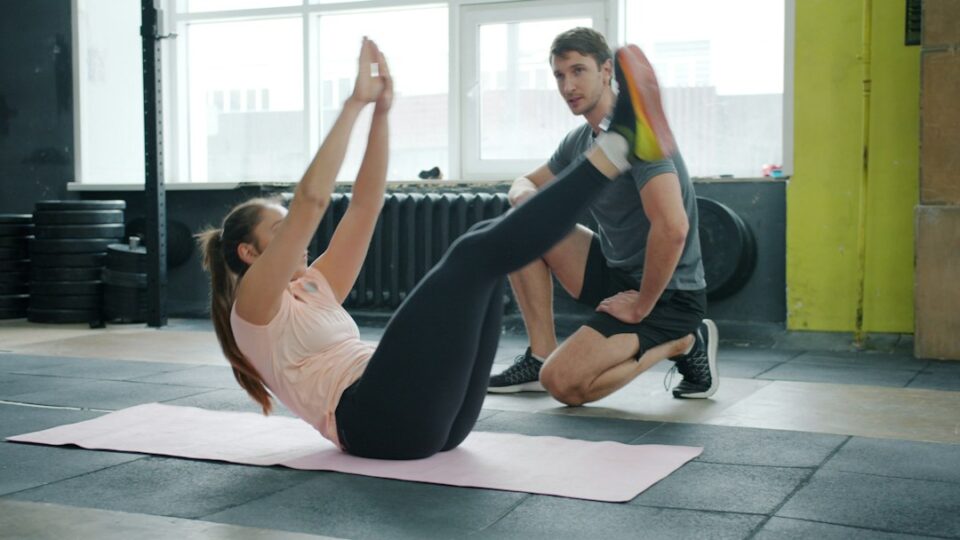
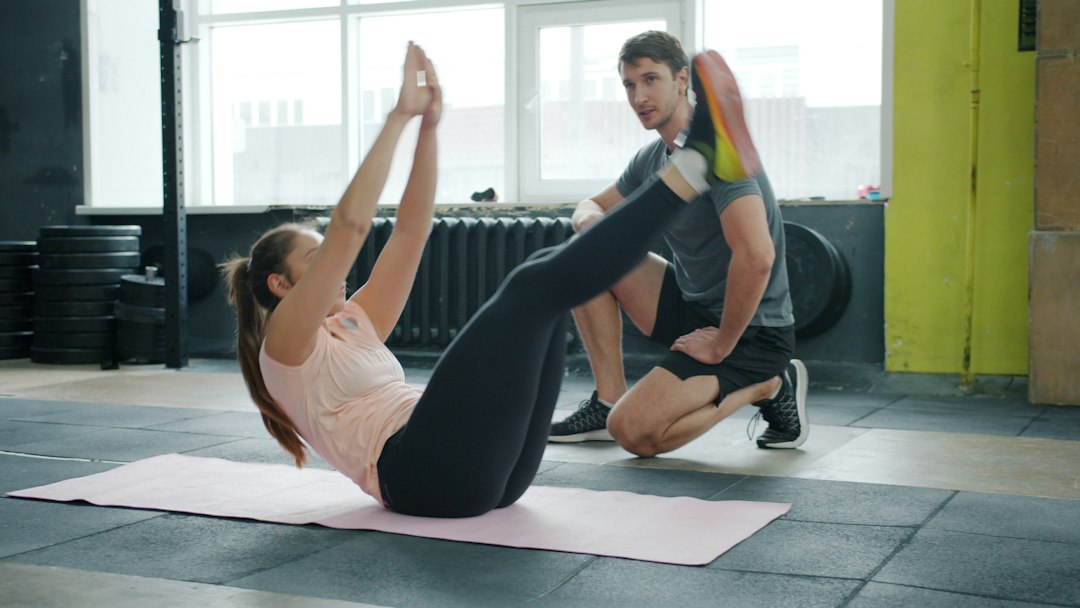
Ab toe touches are a floor ab exercise where you lie on your back, raise your legs vertically, and crunch up to reach toward your toes using your abs—not your neck or hip flexors. They primarily hit the rectus abdominis with support from the transverse abdominis and obliques and can be done anywhere.
Start with 2–3 sets of 8–15 slow reps at about a 2-1-2 tempo, keeping your lower back gently pressed to the floor. If tight hamstrings limit you, bend your knees slightly or reach to your shins instead of toes. Focus on lifting your shoulder blades first and reaching second, so the abs—rather than your arms or hip flexors—do the work.
How to do ab toe touches (quick start, cues, and safe progress)
Here’s a simple, safe way to learn the move so you feel it in your abs, not your neck or lower back.
Setup
- Lie on your back with your legs straight up over your hips. If your hamstrings feel tight, bend your knees 10–30 degrees.
- Point your toes toward the ceiling. Reach your arms straight up so your hands are above your shoulders, palms facing each other.
- Gently press your lower back toward the floor by “tucking your tail” (posterior pelvic tilt). Think ribs down and pelvis slightly curled.
Execution
- Exhale and brace. Imagine drawing your ribs toward your pelvis.
- Lift your head and shoulder blades by rounding your upper spine. Reach your hands toward your toes or shins without swinging your arms.
- Pause for about one count at the top, keeping your legs still above your hips.
- Inhale as you lower under control until your shoulder blades lightly touch the floor. Maintain the gentle lower-back pressure.
Use a 2-1-2 tempo: two seconds up, one second pause, two seconds down.
Quick-start programming
- Sets and reps: 2–3 sets of 8–15 reps
- Rest: 60–90 seconds between sets
- Frequency: 2–3 times per week
- Intensity: stop each set with 1–2 reps left in the tank
Readiness test and progress ladder
Do the at-home readiness test: lie on your back, tuck your tail slightly, and press your lower back to the floor while you breathe out through pursed lips for 10 seconds. If your lower back stays down without strain, you’re ready to practice the movement.
Progress standards and pass/fail criteria:
- Level 1: Shin reach, knees slightly bent. Goal: 3 sets of 12 reps with no neck strain and no lower-back arching. If you pass, advance.
- Level 2: Toe reach, legs vertical. Goal: 3 sets of 12 controlled reps. Shoulder blades must clearly lift; legs stay still. If you pass, advance.
- Level 3: Weighted toe touch (light dumbbell or small med ball held above your chest). Goal: 3 sets of 10 reps without losing lower-back contact on the floor.
Fail conditions and what to do instead: if your neck hurts, your back arches, or you need to swing your legs or arms to finish reps, regress one step, shorten the range, or slow the tempo.
Tight hamstrings or sensitive lower back?
- Bend your knees 10–30 degrees and reach to your shins.
- Try one-leg-up toe touches: one leg vertical, the other foot planted. Switch legs each set.
- Place a small folded towel under your lower back to feel the pelvic tuck.
- Keep the range shorter and focus on lifting your shoulder blades, not getting to your toes at all costs.
If you want a broader mobility routine that pairs well with core work, see the simple ideas in Unlock Flexibility & Mobility.
Muscles worked and key benefits
Primary muscle: rectus abdominis (the front “six-pack” line). You’ll feel the top half of the abs working hard because you’re bringing your ribcage toward your pelvis.
Secondary muscles: the transverse abdominis (deep corset-like layer) and the internal and external obliques help stabilize your trunk and control the rib-down position. Hip flexors act more like stabilizers when you keep the legs still over your hips rather than lifting them up and down.
Why do them?
- Core strength and control: teaches rib-to-pelvis compression without letting the lower back arch.
- Minimal space and equipment: a floor, a mat, and you’re set.
- Tempo-friendly: slow reps make a small range of motion challenging.
- Bonus mobility: when your legs are vertical, you may notice a gentle hamstring stretch. Keep it gentle; don’t lock your knees or force range.
If you’re building a bigger plan around core and full-body movement, these fit neatly inside a functional routine. For a practical template, browse the guidance in Functional Strength Training: A Practical Guide and the beginner-friendly framework in Strength Training for Beginners.
Common mistakes and easy fixes
- Neck pulling: Grabbing behind your head and yanking can irritate your neck. Fix: keep your gaze slightly up, not at your knees. Reach straight up with relaxed hands or keep thumbs lightly at your temples. Think “lift shoulder blades first, then reach.”
- Lower-back arching: Losing the rib-down and pelvic tuck turns this into a hip-flexor move. Fix: before every rep, gently tuck your tail and think “ribs to pelvis.” If your back peels off the floor, shorten the range or bend your knees.
- Swinging legs or using momentum: When the legs drift forward or the arms swing, the abs get a free ride. Fix: keep your legs stacked over your hips and slow the tempo. If needed, lightly brace your calves with a wall to feel the stillness.
- Reaching with arms instead of lifting with abs: Long arms can fake range without spinal flexion. Fix: imagine your sternum sliding toward your belt line. Stop the rep once your shoulder blades clear the floor.
- Holding your breath: Breath-holding can build pressure but often disrupts rhythm. Fix: exhale on the way up to reinforce the brace, then inhale down.
Form checklist
- Setup: legs vertical or slightly bent; arms reaching up.
- Brace: exhale, ribs down, lower back gently into the floor.
- Reach: lift shoulder blades first, then reach.
- Legs still: no swinging; keep them over your hips.
- Tempo: 2-1-2, smooth and controlled.
- Breathing: exhale up, inhale down.
- Range: stop before your back arches.
- Stop signals: neck strain or back arch = regress or shorten range.
Variations and progressions
Match the variation to your current control, flexibility, and training goal.
Easier options
- Bent-knee shin reach: knees bent 10–30 degrees, reach to shins. Great for tight hamstrings.
- Single-leg up toe touch: one leg vertical, other foot flat on the floor. Alternate legs each rep or set.
- Wall-supported legs: heels lightly resting on a wall above hips; helps hold a still leg position while you learn rib-to-pelvis control.
Oblique options
- Alternating toe touch: reach right hand toward left toes and vice versa to add a small rotational demand. Keep range short and control high.
- Heel or ankle taps: feet on the floor, knees bent, crunch and tap right hand to right heel, then left. A friendly entry point if vertical legs feel out of reach.
Harder progressions
- Weighted toe touch: hold a light dumbbell or small med ball above your chest and perform the same controlled reach.
- Hollow-body toe touch: start in a hollow hold with legs slightly forward of hips, shorter arm reach. Requires rock-solid rib and pelvis control.
- Jackknife/V-up: from lying, lift legs and torso to meet midair. More power and coordination, and more momentum risk; attempt only after you own the basics.
Equipment tweaks: a small med ball or 5–10 lb dumbbell raises the challenge; a yoga strap looped around your feet can give a reach target without overextending the neck.
Ab toe touches vs other ab moves: which should you pick?
All ab exercises aren’t interchangeable. Here’s how ab toe touches compare to a few popular choices so you can match the move to your goal.
| Move | Difficulty (1–5) | Primary emphasis | Flexibility demand | Momentum risk | Equipment | Best for |
|---|---|---|---|---|---|---|
| Ab toe touch | 2–3 | Rib-to-pelvis flexion (rectus abdominis) | Medium (hamstrings, if legs vertical) | Low | None; optional light weight | Time-under-tension control |
| Cru nch | 2 | Upper rectus abdominis | Low | Low | None | Entry-level core control |
| Reverse crunch | 3 | Lower abs bias with posterior pelvic tilt | Low | Low | None | Pelvic tuck practice |
| Jackknife/V-up | 4–5 | Full-body power and coordination | Medium | Medium–High | None | Explosive core work |
| Hollow hold | 3–4 | Anti-extension and global tension | Low | Low | None | Static core endurance |
Summary: a crunch and an ab toe touch both flex the spine, but the toe touch adds a leg position that encourages a stable pelvis and a slightly greater flexibility demand. The reverse crunch more strongly biases the lower portion of the abs with the pelvis rolling up; it’s a great pairing with toe touches. V-ups are a higher-skill progression with more momentum risk. Choose based on whether you want controlled tension (toe touch), lower-ab bias (reverse crunch), or power and coordination (V-up).
How to program them in your week
Place ab toe touches after your general warm-up and before heavy lifts if you use them as a primer for rib-to-pelvis control, or finish a session with them if you prefer a core burn.
- General prescription: 3–8 total hard sets per week, 8–15 reps per set, stop with 1–2 reps in reserve. Spread across 2–3 sessions.
- Tempo: keep 2-1-2 unless you’re intentionally doing a slow-eccentric block.
- Rest: 60–90 seconds. If pairing in a circuit, rest as needed to preserve form.
- Progression: every 1–2 weeks, add a rep or two, slow the eccentric by a second, or add a small load above your chest.
Try this 10-minute core finisher when time is tight:
- 3 rounds: 12 toe touches, 20-second side plank per side, 10 reverse crunches
- Rest 60 seconds between rounds
Fuel and recovery matter too. For a concise primer on how nutrition supports training, check Fuel Your Body for Performance.
FAQs about toe touches
What are the benefits of doing toe touches? Toe touches build rib-to-pelvis control, strengthen the rectus abdominis with support from the deep core, and can be done anywhere with little space. With legs vertical, you may also feel a light hamstring stretch, but keep the knees soft and avoid forcing range.
Are toe touches good for abs? Yes—when done slowly with a slight pelvic tuck and controlled reach. They emphasize the rectus abdominis and teach you to lift your shoulder blades without arching your back.
What is another name for toe touches? Many coaches call them toe touch crunches, vertical toe touches, or toe reach crunches.
Is a standing toe touch the same as an ab toe touch? No. Standing toe touches are a hamstring-forward fold stretch. Ab toe touches are a floor core exercise that focuses on rib-to-pelvis flexion with minimal hip motion. Don’t mix them up.
How many ab toe touches should I do per workout? Most lifters do well with 2–3 sets of 8–15 reps, 2–3 days per week, leaving 1–2 reps in reserve. If form fades, stop the set, rest, and do another clean set.
What is the hardest ab exercise ever, and how do toe touches compare? Opinions vary, but advanced moves like ab wheel rollouts from the feet, strict dragon flags, or strict hollow rocks are often cited as extremely challenging. Toe touches sit in the moderate range: more demanding than a basic crunch, far easier than a V-up or dragon flag, and excellent for building the control that those harder exercises require.
Where should I feel it? Primarily in the upper to midline abs as your ribs move toward your pelvis. If you feel your hip flexors working more than your abs, shorten the range and reset your pelvic tuck.
How should I breathe? Exhale during the lift to help the ribs slide down, pause briefly, then inhale during the controlled descent.
What’s the difference between toe touches and toe taps? Toe taps usually refer to tapping your toes on the floor from a tabletop position, focusing on hip movement and pelvis control. Toe touches involve a higher trunk flexion demand and a reaching action toward vertical legs.
How do I know I’m ready to progress? When you can complete 3 sets of 12 clean reps with no neck strain, no leg swing, and no lower-back arching, raise your reach target (toes instead of shins) or add a light external load.
Ab toe touches are simple, portable, and effective when you respect the basics: ribs down, gentle pelvic tuck, legs still, and a steady tempo. Add them to your week for controlled core work that makes other movements stronger and steadier.